
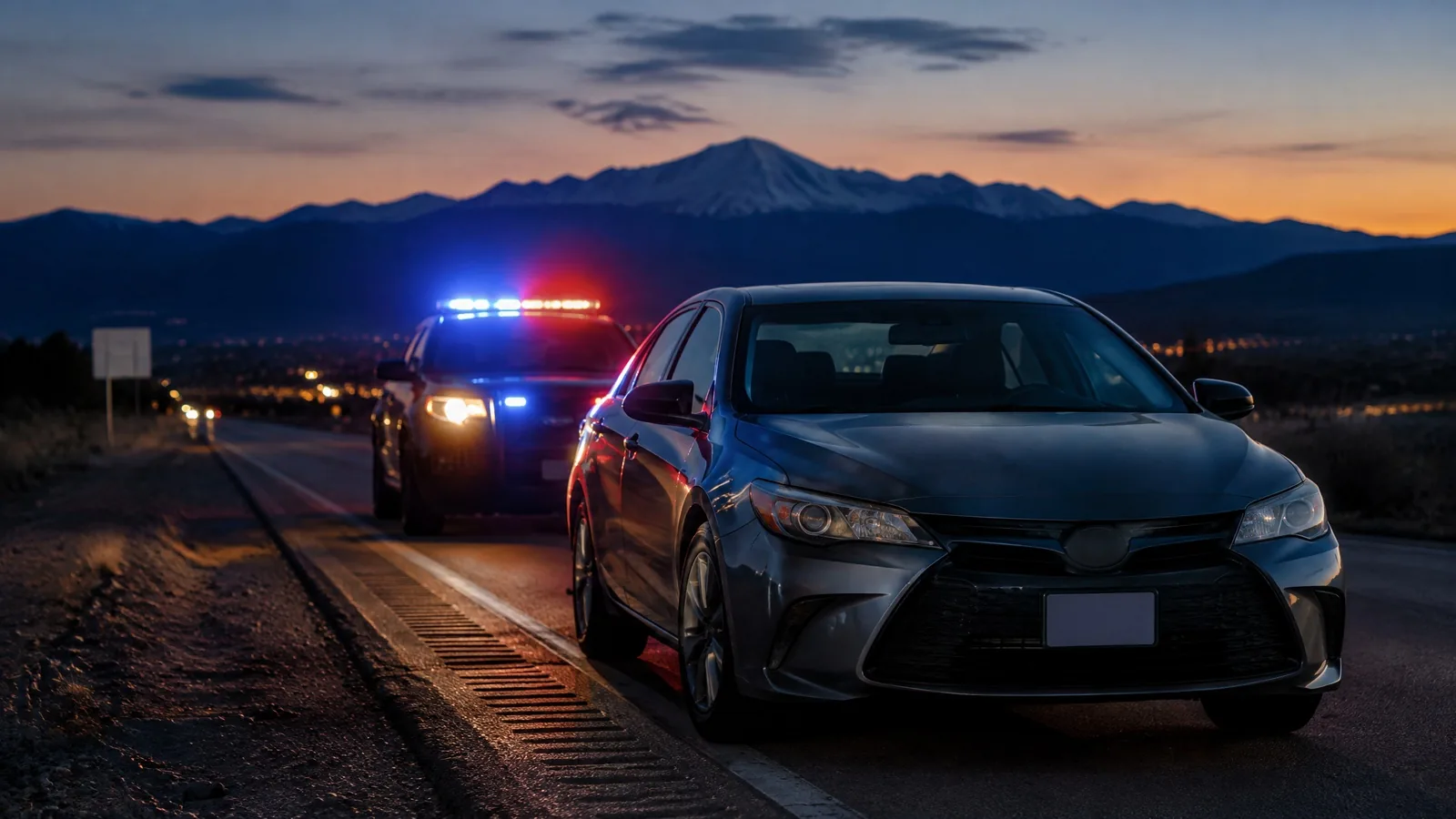
Arrested for DUI in Colorado Springs? What Happens First
A DUI arrest in Colorado Springs starts two separate cases at the same time. One is the criminal case in court, where the prosecution has to prove the charge. The other is an administrative case at the Colorado Division of Motor Vehicles, which decides whether to revoke your driver’s license.
The DMV case moves fast. If the officer took your license and handed you an Express Consent Affidavit and Notice of Revocation, you generally have only 7 days to request a hearing. Miss that window and the revocation takes effect on its own, no matter how the criminal case turns out.
Most people arrested for DUI have never been in a courtroom as a defendant. The sections below walk through what Colorado law says, what penalties are on the table, how the license case works, and where a defense lawyer can make a difference. If you were arrested in the last few days, the license deadline is the first thing to deal with.
Your First Week After a DUI Arrest
- Find your paperwork. Keep the summons, the notice of revocation, any breath test printout, and your bond paperwork together.
- Mark the 7-day deadline. Count 7 days from the day you received the notice of revocation, which is usually the day of the arrest.
- Follow your bond conditions. Many courts order no alcohol while the case is open, and a violation can land you back in jail.
- Write down what you remember. Note where you were, what you ate and drank and when, and what the officer said and did. Details fade quickly.
- Do not discuss the case online. Posts and messages can become evidence.
- Talk to a defense lawyer before the hearing request deadline. The hearing is your first chance to question the arresting officer under oath.
On This Page
- How Colorado Defines DUI, DUI Per Se, and DWAI
- Colorado DUI Penalties by Offense
- Your License: The 7-Day Deadline and the DMV Hearing
- How a DUI Case Moves Through Court
- How DUI Charges Are Challenged
- Consequences Beyond the Courtroom
- Working With a Colorado Springs DUI Lawyer
- Frequently Asked Questions
- Sources
How Colorado Defines DUI, DUI Per Se, and DWAI
Colorado’s main impaired driving statute is C.R.S. 42-4-1301. It creates several related offenses, and the one you are charged with shapes everything that follows. Prosecutors often file more than one of them for the same stop.
| Offense | What the prosecution must show |
|---|---|
| DUI (driving under the influence) | Alcohol, drugs, or both left you substantially incapable of exercising clear judgment, physical control, or due care in driving. |
| DUI per se | Your blood or breath alcohol concentration (BAC) was 0.08 or more at the time of driving or within two hours after driving. |
| DWAI (driving while ability impaired) | Alcohol, drugs, or both affected you to the slightest degree, so you were less able to drive safely than you otherwise would have been. |
BAC numbers also create what the law calls permissible inferences. A BAC above 0.05 but below 0.08 allows a jury to infer impairment for DWAI. A BAC of 0.08 or more allows an inference that the driver was under the influence. These are inferences, not automatic convictions, and a jury can weigh them against other evidence.
DUI Involving Marijuana or Other Drugs
Colorado treats drugged driving under the same statute. For marijuana, a blood test showing 5 nanograms or more of active THC per milliliter of whole blood gives rise to a permissible inference that the driver was under the influence. That inference can be challenged, because THC levels do not track impairment the way alcohol levels do.
Prescription medications, over-the-counter drugs, and controlled substances can all support a DUI or DWAI charge. These cases usually turn on a blood test and on a drug evaluation performed by a specially trained officer. Our Colorado Springs DUID page covers drugged driving charges in more detail.
Colorado DUI Penalties by Offense
Criminal penalties for DUI, DUI per se, and DWAI are set by C.R.S. 42-4-1307. The first three offenses are misdemeanors. Every conviction also carries an alcohol and drug evaluation and court-ordered education or treatment based on that evaluation.
| Conviction | Jail | Fine | Useful public service |
|---|---|---|---|
| First DUI or DUI per se | 5 days to 1 year | $600 to $1,000 | 48 to 96 hours |
| First DWAI | 2 to 180 days | $200 to $500 | 24 to 48 hours |
| Second offense (any of the three) | 10 days to 1 year | $600 to $1,500 | 48 to 120 hours |
| Third offense (any of the three) | 60 days to 1 year | $600 to $1,500 | 48 to 120 hours |
| Fourth or later offense | Class 4 felony (see below) | ||
On a first DUI, the court can suspend the 5-day minimum jail term if you complete the Level I or Level II alcohol and drug program the evaluation recommends. The court may also impose up to two years of probation on a first offense. A second or third conviction requires at least two years of probation.
Court costs, surcharges, evaluation fees, and class costs come on top of the fine. Our article on how much a DUI costs in Colorado breaks those down.
The Alcohol Evaluation and Level I or Level II Classes
Colorado requires an alcohol and drug evaluation for every DUI, DUI per se, and DWAI conviction under C.R.S. 42-4-1301.3. A probation evaluator reviews your history and your BAC and recommends a program. Level I is an education program. Level II combines education with therapy, and its length depends on your evaluation.
The class requirement shows up twice. The court orders it as part of the sentence, and the DMV may require proof of Level II enrollment or completion before reinstating your license. Starting classes early can sometimes help at sentencing, but that decision should be made with your lawyer.
High BAC and the Persistent Drunk Driver Label
A first DUI with a BAC of 0.20 or more carries a minimum of 10 days in jail instead of 5. The court has some discretion to use county jail alternative programs, but the higher minimum still applies.
Colorado also labels some drivers “persistent drunk drivers” under C.R.S. 42-1-102(68.5). That includes anyone with a BAC of 0.15 or more, anyone who refuses chemical testing, and anyone with two or more alcohol-related driving violations. The label brings longer interlock requirements and Level II therapy before the license can be reinstated.
When a DUI Becomes a Felony
A DUI, DUI per se, or DWAI is a class 4 felony when the driver has three or more prior convictions arising out of separate incidents. Prior DUI, DUI per se, DWAI, vehicular assault, and vehicular homicide convictions all count, and there is no look-back period. A conviction from 20 years ago still counts.
A felony DUI carries a possible prison sentence. If the court grants probation instead, it must order either 90 to 180 days in county jail or 120 days to two years served through a county work-release program. Felony charges also arise when impaired driving causes serious bodily injury (vehicular assault) or death (vehicular homicide), regardless of prior record.
Your License: The 7-Day Deadline and the DMV Hearing
License consequences are handled by the Division of Motor Vehicles under C.R.S. 42-2-126, completely separate from the court case. The DMV can revoke your license even if the criminal charge is later reduced or dismissed.
If you took a breath test or refused testing, the officer usually takes your license and gives you a notice of revocation that doubles as a 7-day temporary permit. You have 7 days to request an Express Consent hearing. If you took a blood test, the DMV mails a notice once the results come back, and that notice sets its own deadline.
A timely request keeps you driving on a temporary permit until the hearing. At the hearing, a hearing officer reviews the arresting officer’s paperwork, and your lawyer can subpoena and question the officer. Our DMV hearing page explains that process step by step.
How Long the Revocation Lasts
| Situation (driver 21 or older) | Revocation |
|---|---|
| First offense, BAC 0.08 or more | 9 months |
| First refusal of a chemical test | 1 year |
| Second offense, BAC 0.08 or more | 1 year |
| Second refusal | 2 years |
| Third or later refusal | 3 years |
| Third or later offense, BAC 0.08 or more | 2 years |
A first DWAI does not trigger an administrative revocation, but it adds 8 points to your record. A DUI or DUI per se conviction adds 12 points under C.R.S. 42-2-127. Drivers under 21 face different revocation rules and lower point thresholds.
Drivers Under 21
Colorado sets a much lower line for drivers under 21. A BAC above 0.02 but below 0.08 is “excess BAC underage” and triggers a revocation of 3 months for a first violation, 6 months for a second, and 1 year for a third. A BAC of 0.08 or more brings the adult DUI consequences. Drivers under 21 also have to wait longer before they can apply for early reinstatement with an interlock.
Out-of-State Drivers and Visitors
Colorado Springs sees many drivers with out-of-state licenses, including visitors, students, and service members stationed here. Colorado cannot take away a license another state issued, but it can revoke your privilege to drive in Colorado. According to the Colorado DMV, that hold stays on the National Driver Register until you meet every reinstatement requirement and the revocation period ends. Your home state may act on it as well.
Refusing a Breath or Blood Test
Under Colorado’s Express Consent law, C.R.S. 42-4-1301.1, anyone who drives in the state has agreed to a breath or blood test if an officer has probable cause to believe they were driving under the influence. Refusing that test brings a revocation of at least one year and the persistent drunk driver label.
The roadside handheld breath device is different. Officers must tell drivers 21 and older that they may refuse that preliminary screening test. Roadside coordination exercises, often called field sobriety tests, are also voluntary.
Getting Back on the Road With an Ignition Interlock
Most drivers 21 and older can apply for early reinstatement with an interlock-restricted license under C.R.S. 42-2-132.5. After a BAC revocation, a driver 21 or older can apply at any time, including right away. After a refusal, the wait is two months.
The interlock term depends on the case. A first offender with a BAC below 0.15 who completes four consecutive months on the device with no violations may be eligible to have it removed early. Drivers with a BAC of 0.15 or more, or who refused testing, generally face a two-year interlock requirement. Reinstatement also requires SR-22 insurance and a reinstatement fee.
Interlock Rules Changing on June 1, 2027
The legislature passed HB26-1242 in 2026. Beginning June 1, 2027, for revocations on or after that date, a person whose license is revoked for a first DUI, DUI per se, or BAC of 0.08 or more will have to hold an interlock-restricted license for nine consecutive months after reinstatement before getting any other license, unless they qualify for early removal. The same law repeals the two-month waiting period for early reinstatement after a refusal.
In practice, first offenders will no longer be able to wait out the revocation and skip the interlock. If your case is pending as that date approaches, the timing of your plea and reinstatement may matter. Talk to your lawyer about how the change affects you.
How a DUI Case Moves Through Court
Most DUI cases in El Paso County are filed in El Paso County Court and heard at the El Paso County Judicial Building, 270 S. Tejon Street, in downtown Colorado Springs. Arrests in Woodland Park and the rest of Teller County go to the Teller County Combined Court in Cripple Creek. Both counties are part of the 4th Judicial District.
We also handle DUI cases in Pueblo County (10th Judicial District, Pueblo Combined Court at 501 N. Elizabeth Street) and Fremont County (11th Judicial District, 136 Justice Center Road in Cañon City). The date and courtroom for your first appearance are printed on the summons the officer gave you.
A typical misdemeanor DUI case moves through these stages:
- First appearance or arraignment. The court advises you of the charges and your rights, and sets bond conditions, which often include a ban on drinking and sometimes alcohol monitoring.
- Discovery. The prosecution turns over the police reports, body camera and dash camera video, and breath or blood test records.
- Pretrial conference and negotiation. Your lawyer and the prosecutor discuss the evidence. Some cases resolve with a plea to a reduced charge such as DWAI.
- Motions hearing. If the stop, the arrest, or the testing was unlawful, your lawyer can ask the judge to suppress evidence.
- Trial. You have the right to a jury trial. The prosecution must prove every element beyond a reasonable doubt.
- Sentencing. If there is a conviction, the court imposes the penalties described above, usually with probation supervising the classes and community service.
Can a DUI Be Reduced?
Reduced charges are possible, but Colorado limits them. Under C.R.S. 42-4-1301(4), a court cannot accept a plea from a DUI charge down to a non-alcohol traffic offense unless the prosecutor states in good faith that the case cannot be proven. In practice, the most common reduction is from DUI to DWAI, which carries lower penalties and no administrative revocation on a first offense.
Whether a reduction is available depends on the evidence. Problems with the stop, the testing, or the officer’s account give your lawyer something to negotiate with.
What Is in a Typical DUI Case File
- The officer’s written report and the probable cause affidavit
- Body camera and dash camera video
- The Express Consent affidavit and notice of revocation
- Breath test printouts and the machine’s certification and maintenance records
- Blood draw records, chain-of-custody forms, and the lab report
- Any 911 calls or dispatch records that led to the stop
Reviewing that file line by line, and comparing it against the video, is where most DUI defense work happens.
How DUI Charges Are Challenged
Every DUI case is built from a chain of events: the reason for the stop, the officer’s observations, the roadside exercises, the arrest, and the chemical test. A weak link anywhere in that chain can change the outcome. No lawyer can promise a particular result, but these are the areas a defense review examines.
The Traffic Stop
An officer needs reasonable suspicion of a traffic violation or a crime to pull you over. If the stop was not lawful, evidence gathered afterward may be suppressed. Video from the patrol car often shows whether the claimed driving behavior actually happened.
Probable Cause for the Arrest
To arrest you, the officer needs probable cause to believe you were impaired. Officers commonly rely on the odor of alcohol, bloodshot eyes, slurred speech, and performance on roadside exercises. Each of those observations can have an innocent explanation, such as fatigue, allergies, a medical condition, or uneven pavement.
Breath Test Results
Colorado’s evidential breath tests are run on machines that must be certified and maintained under state health department rules. Operators must be certified as well. Maintenance records, the observation period before the test, and the machine’s own printouts can all reveal problems.
Blood Test Results
Blood samples have to be drawn, stored, and tested correctly. Chain-of-custody gaps, improper storage, and lab procedures can all affect the result. For DUI per se, the test must reflect your BAC within two hours of driving, and evidence that you drank after you stopped driving can rebut the result.
Medical Conditions and Other Explanations
Some signs officers read as impairment have ordinary causes. Diabetes can produce symptoms that look like intoxication, and acid reflux can bring alcohol from the stomach into the mouth, which is one reason breath tests require an observation period first. Injuries, age, weight, footwear, and weather all affect how a person performs roadside exercises.
These explanations need support, such as medical records or testimony, but they can give a jury reason to doubt the officer’s conclusions.
The Express Consent Advisement
Officers must properly advise drivers of the Express Consent law. Mistakes in that advisement, or in how a refusal was recorded, can matter both in court and at the DMV hearing.
Consequences Beyond the Courtroom
A DUI conviction reaches well past the sentence. It is worth understanding these consequences before deciding how to resolve a case.
- A permanent record. DUI and DWAI convictions are excluded from Colorado’s regular record sealing rules. A narrow exception lets a court seal an otherwise excluded misdemeanor if the district attorney consents or the court makes specific findings, but most DUI convictions stay on the record. A dismissal or acquittal can be sealed. See how long a DUI stays on your record in Colorado.
- Insurance. Reinstatement requires SR-22 proof of insurance, and premiums usually rise.
- Commercial drivers. A DUI conviction or test refusal disqualifies a commercial driver’s license for at least one year, even when the driver was in a personal vehicle.
- Military members. Service members at Fort Carson, Peterson Space Force Base, Schriever Space Force Base, and the Air Force Academy can face command action and on-base driving restrictions in addition to the civilian case.
- Employment and travel. Some employers, professional licensing boards, and foreign countries, including Canada, treat a DUI conviction seriously.
Related reading: our guides on ignition interlock requirements and getting a police report after a crash.
Working With a Colorado Springs DUI Lawyer
Attorney Michael W. Moran has been licensed to practice law in Colorado since 1995. He represents people charged with DUI, DUI per se, DWAI, and drugged driving in El Paso, Teller, Pueblo, and Fremont counties. He also handles the DMV hearing that runs alongside the criminal case.
A first meeting covers the timeline of your arrest, the paperwork you received, your license deadline, and the evidence the prosecution is likely to rely on. From there, you get a straightforward assessment of your options, whether that is challenging the evidence, negotiating, or going to trial.
Criminal Defense Colorado Springs, P.C. offers free consultations. Because the 7-day DMV deadline runs from the day you receive the revocation notice, usually the day of the arrest, it helps to call as soon as you can.
Frequently Asked Questions
Is a first DUI a felony in Colorado?
No. A first, second, or third DUI is a misdemeanor. A DUI becomes a class 4 felony when the driver has three or more prior impaired driving convictions, or when the crash causes serious bodily injury or death.
Will I go to jail for a first DUI in Colorado Springs?
The minimum sentence for a first DUI is 5 days in jail, but the court can suspend it if you complete the alcohol and drug classes ordered after your evaluation. A BAC of 0.20 or more raises the minimum to 10 days.
How long do I have to save my license after a DUI arrest?
If the officer took your license, you generally have 7 days to request an Express Consent hearing with the DMV. If you took a blood test, follow the deadline on the notice the DMV mails to you.
What is the difference between DUI and DWAI?
DUI requires proof that you were substantially incapable of driving safely, while DWAI requires proof that you were impaired to the slightest degree. DWAI carries lower penalties. Read more in DWAI vs. DUI in Colorado.
Can I refuse a field sobriety test in Colorado?
Yes. Roadside coordination exercises and the handheld preliminary breath test are voluntary for drivers 21 and older. Refusing the evidential breath or blood test after an arrest is different and leads to a license revocation of at least one year.
Do I have to go to court for a DUI in Colorado Springs?
Yes. A DUI is a criminal charge, not a ticket you can pay by mail. You must appear on the date on your summons unless the court excuses you, and missing court can lead to a warrant.
Can my DUI be reduced to a non-alcohol offense?
Only in limited cases. Colorado law bars a plea from DUI down to a non-alcohol traffic offense unless the prosecutor represents that the case cannot be proven. A reduction to DWAI is more common.
I live out of state. What happens to my license?
Colorado revokes your privilege to drive in Colorado and places a hold on the National Driver Register until you complete reinstatement. Your home state may impose its own penalties based on that record.
Should I take a breath test or a blood test?
After an arrest, Colorado generally lets you choose between breath and blood. Each has different strengths and weaknesses as evidence, and a refusal carries its own penalties. If you have not been arrested yet, this is a good question to ask a lawyer before you ever need the answer.
Can a DUI be sealed in Colorado?
Generally, no. DUI and DWAI convictions are excluded from regular sealing, although a court can seal an otherwise excluded misdemeanor if the district attorney consents or the court makes specific findings. A DUI charge that ends in dismissal or acquittal can be sealed.

Sources
- C.R.S. 42-4-1301, Driving under the influence, driving while impaired, and driving with excessive alcoholic content
- C.R.S. 42-4-1307, Penalties for traffic offenses involving alcohol and drugs
- C.R.S. 42-4-1301.1, Expressed consent for testing
- C.R.S. 42-2-126, Revocation of license based on administrative determination
- C.R.S. 42-2-127, Point system
- C.R.S. 42-2-132.5, Interlock-restricted licenses
- C.R.S. 42-1-102(68.5), Definition of persistent drunk driver
- HB26-1242, Interlock Device for Impaired Drivers (Colorado General Assembly)
- Express Consent Cases Procedures (Colorado Department of Revenue)
- C.R.S. 42-4-1301.3, Alcohol and drug evaluations
- Out-of-State Drivers and DUI (Colorado Division of Motor Vehicles)


