
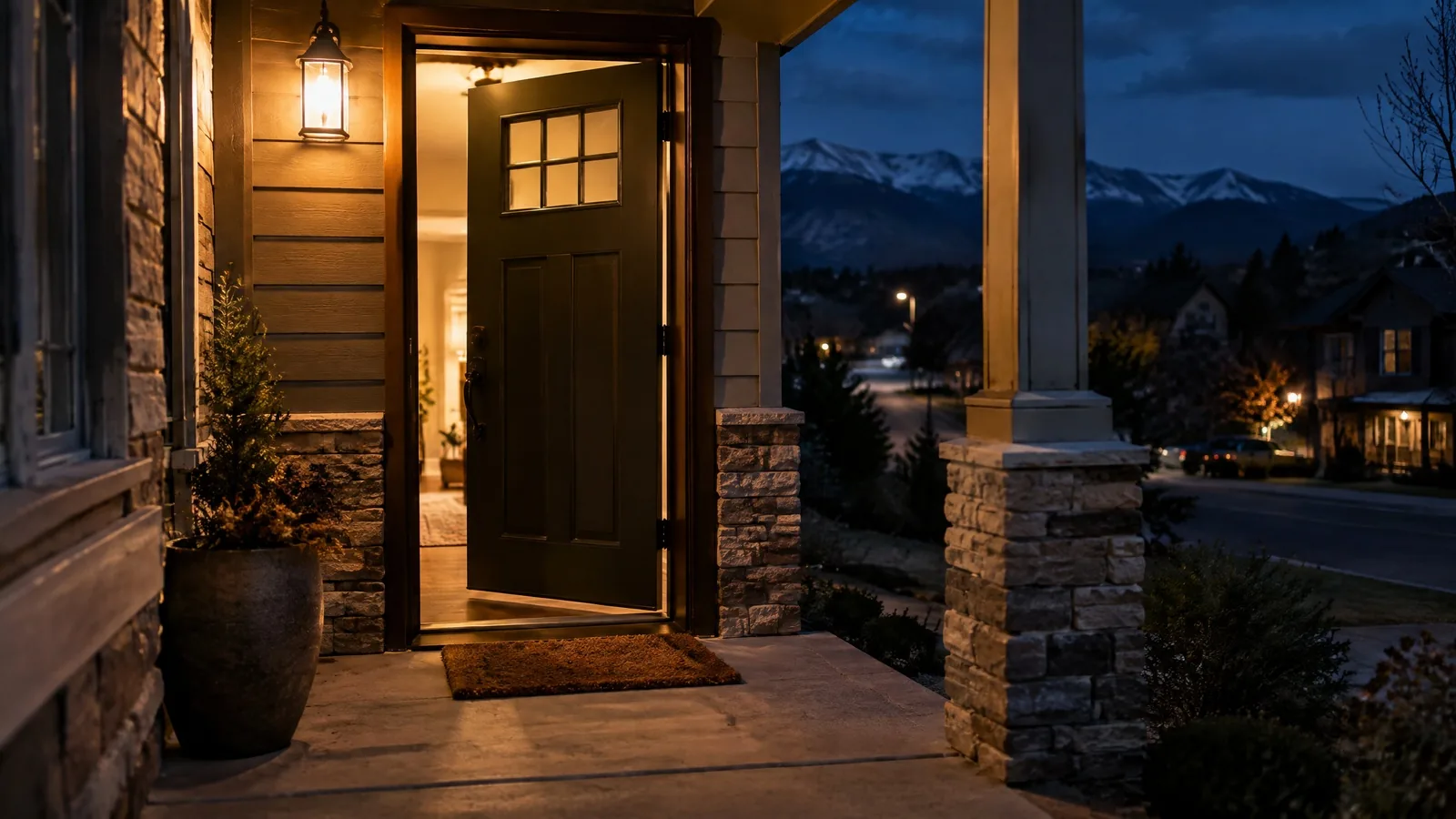
What the Make My Day Law Does
Colorado’s “Make My Day” law is the state’s version of a castle doctrine. Under C.R.S. 18-1-704.5, an occupant of a dwelling may use any degree of physical force, including deadly force, against a person who has made an unlawful entry into the dwelling, if the occupant reasonably believes certain things about the intruder. An occupant who qualifies is immune from criminal prosecution and from civil liability.
Colorado has no statute called “stand your ground,” but its courts have long held that a person who is not the initial aggressor has no duty to retreat before using reasonable force in self-defense, at home or anywhere else. Outside the home, though, the ordinary self-defense statute applies, and its limits on deadly force are stricter than the Make My Day law.
This article explains how these laws are applied after the fact by police, prosecutors, judges, and juries. It is not guidance on when to use force.
On This Page
- The Four Requirements for Immunity
- Immunity From Prosecution and the Pretrial Hearing
- What the Make My Day Law Does Not Cover
- Ordinary Self-Defense Under C.R.S. 18-1-704
- Does Colorado Have a Duty to Retreat?
- Defense of Premises and Property
- How Self-Defense Works at Trial
- What Happens After a Self-Defense Incident
- Working With a Colorado Springs Defense Lawyer
- Frequently Asked Questions
- Sources
The Four Requirements for Immunity
The Colorado Supreme Court has described the statute as having four conditions. In People v. Rau, 2022 CO 3, a case that arose in Colorado Springs, the court listed them as:
- Occupant of a dwelling. The person using force must be an occupant of the dwelling where it happened.
- Unlawful entry. The other person must have made an unlawful entry into the dwelling.
- Reasonable belief of a crime. The occupant must reasonably believe the intruder has committed a crime in the dwelling in addition to the uninvited entry, or is committing or intends to commit a crime against a person or property in addition to the entry.
- Reasonable belief of possible force. The occupant must reasonably believe the intruder might use any physical force, no matter how slight, against any occupant.
What “Unlawful Entry” Means
In People v. McNeese (1995), the Colorado Supreme Court held that unlawful entry means an entry in knowing violation of the criminal law. A civil dispute, such as a broken lease term, does not make an entry criminal.
The court also explained that “uninvited” and “unlawful” are not the same thing. A person can be unwelcome and still be lawfully present.
What Counts as a “Dwelling”
Colorado defines a dwelling as a building used, intended to be used, or usually used by a person for habitation. The Supreme Court has treated an attached garage as part of a dwelling. In Rau, it held that a shared, locked basement in a converted apartment house was part of the defendant’s dwelling.
The court in Rau was careful to say it was not deciding that every common area in shared housing is part of a dwelling. Apartment hallways, shared yards, and similar spaces can still be contested.
Immunity From Prosecution and the Pretrial Hearing
Most defenses are decided by a jury. The Make My Day law is different: subsection (3) grants immunity from criminal prosecution, and subsection (4) grants immunity from civil liability for resulting injury or death.
Because it is immunity, a person charged with a crime can file a pretrial motion asking the judge to dismiss the case. The judge holds an evidentiary hearing. At that hearing, the accused carries the burden of proving each condition by a preponderance of the evidence, meaning more likely than not, as the Supreme Court confirmed in Rau.
If the Motion Is Denied
A denied motion does not end the issue. Under Rau, the accused may still raise the same conditions at trial as an affirmative defense. At trial, as Guenther, Wood, and C.R.S. 18-1-407 provide, the prosecution must disprove it beyond a reasonable doubt.
Timing matters: under Wood v. People (2011), a pretrial denial of immunity cannot be reviewed after trial. The accused can only ask the Colorado Supreme Court to review it before trial under C.A.R. 21, which that court may decline.
What the Make My Day Law Does Not Cover
Many people assume the law covers their whole property, their car, or anyone they want out of the house. It does not.
Yards, Porches, and Doorsteps
The statute protects force used against a person who has entered the dwelling. In People v. Howell, 2024 CO 42, the court held that an uncovered, unenclosed, and unsecured doorstep is not part of a dwelling.
Quoting its 1987 decision in People v. Guenther, the court said the immunity does not extend to force used against non-entrants.
A person standing in the yard, on the driveway, or on an open front step has not entered the dwelling. Force used against that person is judged under ordinary self-defense rules, not the Make My Day law.
Vehicles
The statute is written around a dwelling, which Colorado law defines as a building used for habitation. We did not locate any Colorado appellate decision applying the immunity to an ordinary car or truck. A person who uses force in or near a vehicle should expect the case to be evaluated under C.R.S. 18-1-704.
Businesses
The Make My Day statute covers occupants of a dwelling only. A store, office, or shop where no one lives is not a dwelling under the statute’s definition. Business owners and employees still have ordinary self-defense rights, and 18-1-704 separately allows deadly force, if lesser force reasonably seems inadequate, against a burglar using or about to use force against an occupant of a business.
Guests and People Lawfully Present
Someone invited into the home, a roommate, or a person let in by another resident has generally not made an unlawful entry. McNeese also held that the statute protects against people who unlawfully enter, not people who unlawfully remain after being told to leave.
That means an argument with a guest who refuses to go, or a fight with a household member, is usually analyzed as ordinary self-defense. Many of these cases are filed as domestic violence charges.
Detention Facilities
Subsection (5) of the statute provides that a dwelling does not include any place of habitation in a detention facility. Jail and prison housing units are excluded.
Ordinary Self-Defense Under C.R.S. 18-1-704
Outside the narrow reach of the Make My Day law, C.R.S. 18-1-704 controls. A person may use physical force to defend themselves or a third person from what they reasonably believe is the use or imminent use of unlawful physical force. The force must be the degree the person reasonably believes is necessary.
Limits on Deadly Physical Force
Deadly physical force is justified only if a lesser degree of force is reasonably believed to be inadequate and one of these applies:
- the person reasonably believes that they or another person are in imminent danger of being killed or receiving great bodily injury;
- the other person is using or about to use physical force against an occupant of a dwelling or business while committing or attempting burglary; or
- the other person is committing or about to commit kidnapping, robbery, sexual assault, or first or second degree assault.
When Self-Defense Is Not Available
- Provocation. The person provoked the use of unlawful force with intent to cause bodily injury or death to the other person.
- Initial aggressor. The person started the confrontation, unless they withdrew, effectively communicated that withdrawal, and the other person continued or threatened to continue using unlawful force.
- Combat by agreement. The force came from a mutual fight not specifically authorized by law.
- Bias-based force. The force was based on the other person’s actual or perceived gender, gender identity, gender expression, or sexual orientation, including after an unwanted nonforcible romantic or sexual advance.
Self-defense comes up most often in assault and menacing cases, and in cases where a gun was displayed or fired. Our weapons charge page covers related firearm charges.
Does Colorado Have a Duty to Retreat?
No, not for a person who is not the initial aggressor. The self-defense statute does not mention retreat, and the rule comes from Colorado Supreme Court decisions.
- Idrogo v. People, 818 P.2d 752 (Colo. 1991). This case arose from a fatal stabbing in Colorado Springs. The court held that a non-aggressor is not required to retreat before using deadly force when that force is otherwise reasonable, and that the jury should have been given a no-retreat instruction.
- People v. Toler, 9 P.3d 341 (Colo. 2000). The court confirmed that a non-aggressor may claim self-defense without considering whether a reasonable person would retreat.
- Cassels v. People, 92 P.3d 951 (Colo. 2004). The court stated that “only initial aggressors must retreat” and held that the standard self-defense instruction alone did not tell the jury this.
- People v. Monroe, 2020 CO 67. The court held that a prosecutor may not argue that a defendant acted unreasonably in self-defense because she failed to retreat, and it reversed the conviction.
We found no statute that changes this rule, and the current version of 18-1-704 contains no retreat requirement. The no-retreat rule does not make every use of force lawful. The force still has to be reasonable, and deadly force still has to meet the statute’s limits.
Defense of Premises and Property
Two other statutes come up in home and property cases. They allow less force than many people expect.
Defense of Premises
Under C.R.S. 18-1-705, a person in possession or control of a building or land, or a person licensed or privileged to be there, may use reasonable and appropriate physical force to prevent or end what they reasonably believe is an unlawful trespass on the property. Deadly force is allowed only in defense of a person under 18-1-704, or when reasonably necessary to prevent an attempt by the trespasser to commit first degree arson.
Defense of Property
Under C.R.S. 18-1-706, a person may use reasonable and appropriate physical force to prevent what they reasonably believe is an attempt to commit theft, criminal mischief, or criminal tampering involving property. Deadly force may be used only in defense of oneself or another under 18-1-704. Protecting a car, a package, or tools in the yard does not, by itself, justify deadly force.
How Self-Defense Works at Trial
For charges that require intent or knowledge, self-defense is an affirmative defense in Colorado. Under C.R.S. 18-1-407, the accused only needs to present some credible evidence on the issue, unless the prosecution’s own evidence already raises it.
Once it is raised, the prosecution must prove guilt beyond a reasonable doubt as to the defense as well as every element of the crime. The accused never has to prove self-defense at trial. If jurors have a reasonable doubt about whether the force was justified, they must acquit.
A Different Rule for Reckless and Negligent Charges
Some charges require only recklessness, extreme indifference, or criminal negligence. For those, 18-1-704(4) still lets the accused present self-defense evidence, and the jury is instructed on the law of self-defense. However, the prosecution does not carry the extra burden of disproving it, and the instruction is not an affirmative defense instruction.
How the charges are filed can therefore change the strength of a self-defense claim.
What Happens After a Self-Defense Incident
Using force, even lawfully, usually starts an investigation. Police may detain or arrest the person who used force while they sort out what happened, and the District Attorney’s office decides whether to file charges. In El Paso County, both misdemeanor and felony cases are heard at the El Paso County Judicial Building, 270 South Tejon Street.
The Make My Day law does not stop an investigation. Its immunity is usually decided by a judge after charges are filed.
Evidence That Often Decides These Cases
- doorbell and security camera video, which may be overwritten within days;
- 911 recordings and the timing of calls;
- physical evidence of a forced entry, such as a broken door or window;
- the location of the other person when force was used, inside or outside the threshold;
- prior threats, texts, or protection orders; and
- statements made to officers at the scene.
People who believe they acted in self-defense often want to explain everything to police right away. Those statements are recorded and can be used later, sometimes to prove the very charge filed. Our post on police investigation tactics explains what to expect in an interview.
Working With a Colorado Springs Defense Lawyer
Attorney Michael W. Moran has been licensed to practice law in Colorado since 1995 and is a former municipal court judge. He represents people charged after self-defense incidents in El Paso, Teller, Pueblo, and Fremont counties, from misdemeanor assault and menacing to serious felony charges.
In a Make My Day case, early work can include preserving video, documenting the scene, and preparing for an immunity hearing. No lawyer can promise a particular result, and each case turns on its own facts.
Criminal Defense Colorado Springs, P.C. offers free, confidential consultations.
Frequently Asked Questions
Is Colorado a stand your ground state?
Colorado has no statute by that name, but Colorado Supreme Court decisions hold that a person who is not the initial aggressor has no duty to retreat before using reasonable force. The force must still meet the limits in C.R.S. 18-1-704.
Does the Make My Day law apply in my yard or on my porch?
Generally, no. The person must have entered the dwelling, and in 2024 the Colorado Supreme Court held that an uncovered, unenclosed, and unsecured doorstep is not part of a dwelling.
Does the Make My Day law apply in my car?
The statute covers dwellings, defined as buildings used for habitation. We found no Colorado appellate decision applying it to an ordinary vehicle, so ordinary self-defense rules would apply.
Who has to prove Make My Day immunity?
At the pretrial hearing, the accused must prove the statute’s conditions by a preponderance of the evidence. If the motion is denied and the issue goes to trial, the prosecution must disprove it beyond a reasonable doubt.
Does the Make My Day law protect me from a lawsuit?
Yes, if its conditions are met. Subsection (4) grants immunity from civil liability for injury or death resulting from force used within the statute.
Does the law cover a guest who refuses to leave?
Usually not. The Colorado Supreme Court has held that the statute applies to a person who knowingly and unlawfully enters, not one who unlawfully remains, so ordinary self-defense rules apply.

Sources
- C.R.S. 18-1-704.5, Use of deadly physical force against an intruder
- C.R.S. 18-1-704, Use of physical force in defense of a person
- C.R.S. 18-1-705, Use of physical force in defense of premises
- C.R.S. 18-1-706, Use of physical force in defense of property
- C.R.S. 18-1-407, Affirmative defense
- People v. Rau, 2022 CO 3 (Colorado Supreme Court)
- People v. Howell, 2024 CO 42 (Colorado Supreme Court)
- People v. Monroe, 2020 CO 67 (Colorado Supreme Court)
- Idrogo v. People, 818 P.2d 752 (Colo. 1991)
- People v. McNeese, 892 P.2d 304 (Colo. 1995)
- People v. Toler, 9 P.3d 341 (Colo. 2000)
- Cassels v. People, 92 P.3d 951 (Colo. 2004)
- Wood v. People, 255 P.3d 1136 (Colo. 2011)
- People v. Guenther, 740 P.2d 971 (Colo. 1987)